Number Four with Heart: A Seasonal Embroidery Review
First Impressions: Romantic, Playful, and Instantly Recognizable
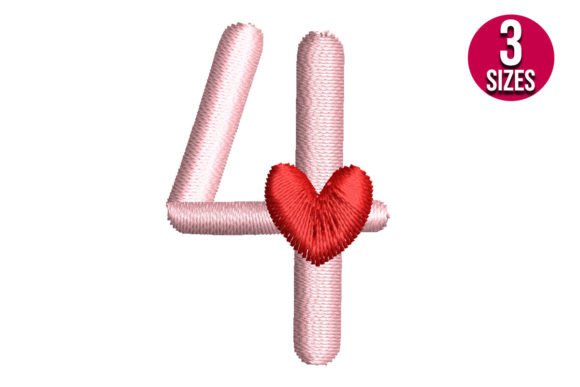
As an embroidery designer who’s curated seasonal collections for over a decade, my first glance at Number Four with Heart landed right where it should — in the sweet spot between Valentine’s Day charm and timeless simplicity. It’s not overly ornate, yet it carries emotional weight: soft curves, a centered heart that feels sincere (not saccharine), and balanced proportions that read clearly even at small scale. The design leans into cute and romantic, but avoids cliché — no Cupids or roses here. Instead, it offers quiet confidence: four as a number of stability, paired with a heart as warmth. That duality makes it unexpectedly versatile for seasonal embroidery: think family matching sweatshirts for February birthdays, “Four Years Together” pillow covers, or “Our Fourth Valentine’s” kitchen towel sets.
Real-World Holiday Selling Scenarios Where It Shines
Number Four with Heart performs exceptionally well in high-intent holiday shopping moments. On Etsy, it stands out in search results for “Valentine’s Day embroidery” and “personalized gift” — especially when styled in mockups on neutral-toned sweatshirts or linen tote bags. At craft fairs, it reads beautifully on embroidered patches pinned to denim jackets or stitched onto cotton aprons — tactile, warm, and human-scaled. For limited-edition apparel drops, pairing it with minimalist typography (“Est. 2021”) creates cohesive branding without overwhelming the design.
It’s also ideal for gift bundles: imagine a set including a tote bag design, a kitchen towel embroidery, and a small pillow cover — all anchored by the same motif. Social media previews gain traction because Number Four with Heart is instantly legible in thumbnail size and evokes shared milestones (anniversaries, baby’s fourth month, friendship anniversaries). And for printable promotional graphics? Its clean lines translate flawlessly into flat vector-style previews — no pixelation, no lost detail.
Where to Use It Thoughtfully — Not Everywhere
While charming, Number Four with Heart isn’t universally forgiving. On thick terry cloth towels or heavy canvas, dense stitching may cause puckering unless paired with firm cutaway stabilizer and reduced stitch density. Dark fabrics demand careful thread color testing — light pinks or creams can vanish; burgundy or charcoal gray thread often delivers richer contrast and emotional resonance. Avoid using it on highly stretchy garments (like ribbed knits) without proper backing and hooping technique — the heart’s curve can distort if tension isn’t calibrated.
Small hoop sizes (under 4x4 inches) require scrutiny: zoom into the heart’s inner curve and number serifs in your embroidery software. If details blur or stitch count balloons unnaturally, consider simplifying or requesting a scaled-down version from the seller. Metallic thread adds glamour but increases breakage risk — reserve it for low-wear items like ornaments or framed wall art, not daily-use tote bags. And for curved surfaces like baseball caps? Skip it — the geometry doesn’t adapt well to complex contours.
How It Elevates Seasonal Appeal & Buyer Trust
Number Four with Heart strengthens seasonal appeal by tapping into milestone psychology — not just romance, but commitment, growth, and continuity. That expands its shelf life beyond February 14th into anniversary markets, baby showers (“Four Months Old”), and even graduation themes (“Class of ’24”). Buyers perceive handmade gifts with this design as intentional and thoughtful — not generic. That perception builds trust, especially for Etsy sellers and small shop owners whose customers value authenticity over mass production.
Visually, it supports brand consistency: whether you’re launching a line of linen home goods or cozy apparel, Number Four with Heart maintains a cohesive tone — warm, grounded, quietly joyful. It encourages engagement, too: shoppers tag friends (“This is us!”), share milestone photos, and return for complementary designs (a “Number Five with Star,” perhaps). In crowded holiday feeds, its clarity cuts through noise — no decoding needed, just instant recognition and emotional resonance.
Practical Designer Notes Before You Stitch
- Test thread colors on both light and dark fabric swatches — especially around the heart’s interior curve where shadowing matters.
- Check stitch density in your embroidery software. High density works on stable fabrics; reduce fill density by 10–15% for towels or textured linens.
- Confirm hoop size before digitizing or purchasing — some versions may be optimized for 5x7”, others for smaller formats.
- Use appropriate stabilizer: medium-weight cutaway for knits, tear-away for stable wovens, and fusible + tear-away combo for lightweight cottons like pillow covers.
- Create realistic mockups — not just white backgrounds. Show it on oatmeal-colored sweatshirts, navy totes, and cream kitchen towels to reflect real customer choices.
- Review small details after stitching: ensure the heart’s point is sharp, the number’s base sits evenly, and no stray stitches pull at fabric edges.
- Plan matching color palettes — pair soft rose with charcoal gray, or sage green with cream, to extend your product line cohesively.
- Verify commercial licensing before selling finished products. As a digital embroidery file, its usage rights determine whether you can offer commercial embroidery services or sell embroidered goods at scale.
Ultimately, Number Four with Heart isn’t just another machine embroidery design — it’s a storytelling tool. When placed thoughtfully on a handmade gift, it transforms ordinary fabric into a vessel for memory. For the Etsy seller, the apparel decorator, or the small business owner building a seasonal collection, it’s a quiet investment in emotional connection — one stitch, one heart, one meaningful number at a time.