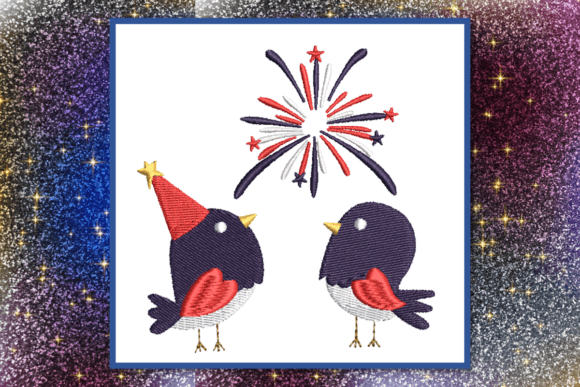
Patriotic Birdie-Fireworks
A Cheerful, Compact Spark for Holiday Embroidery Projects
As someone who’s stitched hundreds of holiday designs—from intricate fireworks bursts to layered flag motifs—I opened Patriotic Birdie-Fireworks expecting whimsy, and got exactly that: four distinct, lightly stylized birdies, each with a subtle patriotic twist. No heavy stars-and-stripes overload—just a soft nod to Independence Day through tiny star accents, red-and-blue feather hints, and cheerful, upward-swooping silhouettes. It’s the kind of machine embroidery design that lands gently rather than shouts. I immediately pictured it on a linen tea towel for a small-batch boutique, or nestled into the corner of a baby onesie as a quiet, handmade celebration.
Real-World Fit: Where This Design Actually Shines
Last week, I prepped a set of custom embroidered tote bags for a local craft fair vendor—lightweight cotton canvas, medium-weight tear-away stabilizer, 5x7 hoop. I tested Patriotic Birdie-Fireworks at 3.2" wide on one bag, centered just below the strap seam. The result? Crisp, friendly, and unmistakably hand-crafted—not mass-produced. Customers paused, smiled, and asked, “Is that a bird *with* fireworks?” That’s the sweet spot: this design invites engagement without demanding attention. It works beautifully on sweatshirt embroidery where boldness can overwhelm; the birdie’s open shape and modest fill stitch density prevent puckering or stiffness. On baby embroidery? Yes—especially on gauzy swaddles or organic cotton burp cloths, as long as you pair it with ultra-soft stabilizer and reduce top tension slightly.
For Etsy sellers and craft business owners, Patriotic Birdie-Fireworks is a smart digital embroidery file to bundle: offer all four birdies as a themed pack, or let buyers choose one for personalization. I used it on an apron for a bakery’s July 4th staff gift—stitched in navy thread on natural linen—and it read cleanly from six feet away. No bleeding, no skipped stitches, even across the curved waistband seam (thanks to careful placement and light cutaway backing).
Where to Pause—and Plan Ahead
This isn’t a design for ultra-fine detail work. If you’re planning embroidered patches with tight satin stitch borders or dense decorative accents, test the smallest birdie first: its wingtips and beak rely on clean running stitch definition, which can blur on textured fabrics like terry cloth or loosely woven towels. On stretchy fabric—think ribbed knit tees or lightweight jersey—use a firm cutaway stabilizer and consider shortening jump stitches manually in your editing software if your machine allows.
Dark fabric demands extra attention. I ran a quick black-and-white mockup before stitching on charcoal gray sweatshirts—and realized the blue thread needed a brighter tone (navy wasn’t enough contrast). Switching to royal blue improved legibility instantly. Likewise, on thin fabric like chambray shirts or muslin pillow covers, avoid stacking multiple layers of stabilizer unless absolutely necessary; the birdie’s light stitch density means it won’t overpower, but excess backing can show through.
Design Assets That Support Your Brand—Not Complicate It
Patriotic Birdie-Fireworks strengthens handmade presentation because it feels intentional, not clip-art-y. Its scale sits comfortably between “too dainty” and “too dominant”—ideal for small shop product lines where consistency matters. When customers see it on a series of kitchen towels, caps, and baby blankets, they recognize a cohesive holiday collection, not random holiday graphics. That builds trust. And for creative entrepreneurs selling personalized gifts, it’s versatile enough to pair with names (“Emma’s Birdie”) or simple dates (“July 4, 2024”) without visual clutter.
That said—don’t assume licensing covers commercial use out of the gate. If you plan to sell finished products (like embroidered pillow covers) or resell the digital embroidery file itself, verify the terms. Many designers restrict redistribution or require attribution. A quick email to the seller clears up ambiguity fast—and protects your craft business long term.
Practical Designer Notes You’ll Actually Use
- Always test on scrap fabric first—especially when switching between cotton, knits, and blends. Note how the birdie’s tail feathers lay flat versus curl.
- Review stitch density in your editing software. If fill areas look overly dense, reduce density by 5–8% for lightweight fabrics.
- Confirm hoop size compatibility. These birdies are compact, but check whether your version fits comfortably in your most-used hoop without re-hooping mid-stitch.
- Inspect small details at actual stitch-out size. Zoom in on the beak and star accents in your preview window—they should hold shape, not vanish.
- Test thread color contrast on both light and dark backgrounds. What reads well on ivory may disappear on navy unless you adjust hue or saturation.
- Use proper stabilizer for your base fabric—not just what’s on hand. Lightweight tear-away for stable wovens; cutaway for knits or anything that moves.
- Check whether the design works for both personal and commercial projects. Some files include alternate versions (applique design, outline-only) —look for those extras.
Final Thought: A Thoughtful Touch, Not a Themed Afterthought
In a season flooded with loud, pixel-heavy holiday embroidery files, Patriotic Birdie-Fireworks stands out by being quietly confident. It doesn’t try to be everything—it’s a small-scale, high-charm embroidery project asset that earns its place on a child’s onesie, a chef’s apron, or a boutique’s limited-run tea towel. It’s the kind of design that makes customers say, “I love that little bird,” not “Oh, it’s another flag thing.” For embroidery designers, Etsy sellers, and handmade product creators, that distinction is worth more than pixels—it’s personality, built stitch by stitch.