Unicorn Shark Adventure
A Playful Twist That Actually Works on Real Fabric
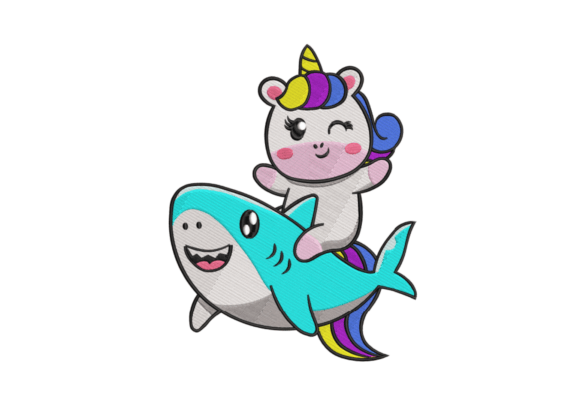
As someone who’s stitched hundreds of machine embroidery designs for clients—from boutique baby onesies to Etsy bestsellers—I opened Unicorn Shark Adventure expecting whimsy, but not quite this much quiet confidence in its own charm. The first thing that lands isn’t the rainbow mane or the shark’s grin—it’s the balance. The unicorn sits comfortably atop the shark’s back, not floating awkwardly or straining the composition. Their shared forward motion creates gentle rhythm, and the ocean suggestion (a subtle wave curl beneath the shark’s tail, not literal water) keeps it light without overloading the stitch count. This isn’t just a “cute idea”—it’s a well-paced embroidery file built for readability at common sizes.
Where It Shines: Real Projects, Real Reactions
Last week, I prepped Unicorn Shark Adventure for a custom embroidered tote bag order—part of a small shop’s summer collection targeting new parents and preschool teachers. We stitched it on medium-weight canvas with tear-away stabilizer and soft cotton thread. The result? Instant recognition and genuine smiles. Customers didn’t say “Oh, a unicorn and a shark”—they said, “That’s *my* kid’s energy.” That’s the difference between decoration and connection. It works especially well on items where joy needs to read from three feet away: sweatshirt embroidery on toddler hoods, baby embroidery on organic cotton burp cloths, and even as an embroidered patch sewn onto denim jackets for craft fair vendors.
I also tested it on a lightweight tea towel—slightly riskier given fabric texture and frequent washing. With a light cutaway stabilizer and reduced top tension, the satin stitch on the unicorn’s horn stayed crisp, and the fill stitch in the shark’s body held clean edges. No puckering. No thread breaks. That tells me Unicorn Shark Adventure was digitized with real-world wear in mind—not just screen appeal.
What You’ll Want to Watch For (Because Real Fabric Isn’t Perfect)
This design lives in the Baby Animals category, but don’t assume it’s only for onesies. Its strength is versatility—but that comes with nuance. On dark fabric, the rainbow mane reads beautifully *if* you choose high-contrast thread colors (think bright fuchsia over navy, not pastel lavender over charcoal). On thin or stretchy fabric like ribbed knit onesies, skip the standard tear-away. Go for a light fusible + tear-away combo to keep those delicate curves stable during stitching.
Curved surfaces—like structured caps or toddler beanies—require extra attention. The shark’s dorsal fin and unicorn’s ear tips are fine details. If your hoop size is tight, those points may compress slightly. Test first on a scrap cap panel. Same goes for dense stitch areas: the rainbow mane uses layered satin stitches, not filler-heavy blocks. That’s smart—it avoids stiffness on baby items—but means you’ll want to verify thread color transitions match your intended palette before stitching 50 units for your Etsy shop.
Design Assets That Build Trust—Not Just Cuteness
Here’s what Unicorn Shark Adventure quietly does right for creative entrepreneurs: it feels handmade without looking amateurish. The smile on the shark isn’t cartoon-simplistic—it has subtle curve variation in the satin stitch that suggests expression, not just shape. That level of detail elevates a personalized gift from “nice” to “thoughtfully made.” For small shop owners building brand consistency, this design slots cleanly into a joyful-but-not-cloying aesthetic—think nursery decor paired with minimalist animal prints or holiday embroidery on linen stockings.
And yes, it photographs well. Whether you’re generating a printable mockup for your Etsy listing or staging a finished product for Instagram, the contrast between the unicorn’s soft curves and the shark’s friendly angularity gives the image visual breathing room. No overcrowding. No competing focal points. Just clear, confident storytelling in thread.
Practical Designer Notes Before You Stitch
- Always test on scrap fabric first—especially if using textured weaves or blends. The ocean wave element is subtle; make sure it reads on your chosen base.
- Review stitch density before scaling up. At 5" wide, the fill areas remain breathable—ideal for baby embroidery—but pushing beyond 6" may require re-digitizing for stability.
- Confirm hoop size compatibility. This design fits comfortably in a 4x4 hoop at its standard size, but check your file metadata—some versions include alternate layouts for larger hoops.
- Inspect small details in your embroidery software: the tip of the unicorn’s horn, the edge of the shark’s smile, and the separation between mane strands. These define clarity.
- Test in black and white mockups too. Does the shape hold up without color? Yes—it does. That’s a sign of strong silhouette design.
- Compare light and dark fabric backgrounds side-by-side. The rainbow effect relies on thread choice, not digital illusion.
- Use proper stabilizer: light cutaway for knits, tear-away for stable wovens, and fusible + tear-away for sheer or slippery fabrics.
- Verify licensing before selling finished items or bundling the digital embroidery file. Not all Embroidery files permit commercial use out of the box—even playful ones like Unicorn Shark Adventure.
Final Thought: Joy With Intention
Unicorn Shark Adventure isn’t trying to be everything. It’s a focused, well-executed piece of design thinking—playful, precise, and purpose-built for real hands and real customers. Whether you’re a craft business owner updating your holiday embroidery lineup, an Etsy seller curating baby-themed digital products, or a hobbyist making a one-of-a-kind pillow cover, this design delivers warmth without sacrificing craft integrity. It reminds us that the best machine embroidery designs don’t shout—they invite. And then they hold up, wash after wash, stitch after stitch.